
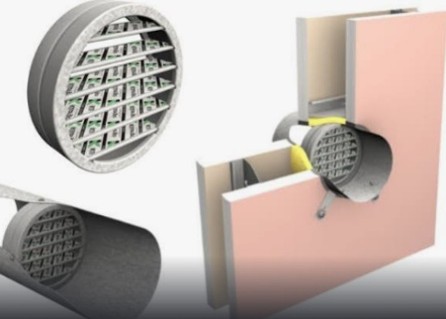
Most multi-level class 2 residential apartment complexes or buildings have fire dampers. These dampers are generally not mechanical, but fixed, open intumescent fire dampers. These types of dampers are designed to close in the event of a fire and heat and keep fire contained to that sole occupant unit. These dampers have special material configured like fixed louvers, that expand to many times there stable size and close of the opening completely.
The fire dampers are an important concealed safety system designed to allow normal extracted air to exit the unit and dissipate via a common ventilated shaft out of the building, generally through the roof.
In the event of fire in a sole occupancy unit or SOU, these intumescent fire dampers will close and prevent smoke, toxic fumes and fire from exiting the SOU in the common ventilation shaft and impact other SOUs in the building.
Under the national construction code NCC, Building Code of Australia, volume 1, each apartment unit is its own independent fire compartment withing the building. Where air conditioning or mechanical ventilation duct breaches the fire rated wall, the opening must be protected with an intumescent fire damper.
Generally, you will find one damper in the wall of the sole occupancy unit leading to a common ventilation shaft that might have an air extraction fan operating continuously or an open shaft at the side or roof of the building.
Within each unit there might be several small fans that remove air, smoke, steam humidity or odours from the kitchen, laundry, bathroom and toilet, that move via duct, maybe the circular silver type. All these ducts lead to the same exit point from the building.
There are other types of dampers may also be found in a residential or commercial building, outside of the sole occupancy unit.
Three Different Sorts Dampers that May be in an Residential Apartment Buildings
Fixed Ducted intumescent fire dampers
These are the most common type of dampers in Sole Occupancy Units SOU, as they can function to prevent the spread of fire, without mechanical components.
Blade or Mechanical Curtain Type of Dampers
The dampers are generally secured in the open position by wire, held together by what is known as weak or fusible link, which is two bits of copper plate soldered together. In the event of a fire the solder holding this fusible link together heats up, melts and allows the metal and wire to separate, causing the louvres to close and maintain fire rated separation between two fire compartments by way of gravity.
Mechanical or Motorised Fire and Smoke Dampers
These types of dampers are generally installed in larger fire or smoke compartments where the air condition or zone pressurisation duct transit from one fire or smoke compartment to another. In most case these dampers are combined fire and smoke and are operated by a small motor that closes the dampers when there is a fire alarm system activation that also shuts down the air conditioning system. For these dampers to operate the air conditioning air flow must cease, in order for the small motor to operate.
Rules Around Installation, identification and Maintenance.
All dampers are installed in accordance with Australian Standard 1682, which calls for specific compliance requirements.
Expansion Gaps: For intumescent fire dampers to work they must expand and it is critical that there is physical clearance gap around the outer frame for them to work properly.
Fire-Rated Sealant: The gap around perimeter between the wall and the damper housing must be packed with compliant and tested fire mastic, like Promat. Promaseal.
Inspection Panels All installed fire or smoke dampers, including ones installed in residential sole occupancy units must have an inspection panel to allow for an annual audit by service contractors and AFSS auditors. Although some dampers in residential building can be visually inspected from the roof with borescope or cable camera, they cannot have dust removed and this is required.
Although Australian Standards 1851-2012 on calls for 20 % inspection per year, all dampers need to be registered in an asset register at the outset.
In many case the dampers may have been certified in the past as being compliant, but the rules have changed in NSW and a only very small amount of fire safety assessor can now certifier and part of the certification is to ensure the dampers have been inspected and maintained in accordance with As1851-2012
If you are needing a competent team that can assess and certifier your fire and smoke dampers, Survival Solution is here to help, so give us a call or send and email and well do our best to get you dampers certified.